


On September 19, 2026, Waymakers joined with the Heravi Peace Institute at Utah State University and the Washington D.C. Temple Visitors’ Center to host Peacemakers Needed, a gathering devoted to helping people navigate interpersonal, interfaith, and political conflict with greater understanding and skill.
Patrick Mason and Thomas Griffith gave a rousing opening, inviting us to a fourth American Revolution. Dr. Ravi Gupta taught us how to have better interfaith dialogue. Jim Ferrell taught us about the importance of connecting relationally. Maybree Spilsbury taught us how to overcome political differences and work collaboratively together.
I gave the closing keynote that afternoon. I didn’t have prepared remarks so what follows is a lightly edited excerpted version of what I said. I’ve removed some of the inevitable errors, repetition and verbal detours that come with speaking off script rather than writing, but otherwise I’ve tried to stay close to what I actually said.
About a month ago, I was in Chicago at the National Conference of State Legislatures (NCSL). Thousands of state legislators and legislative staff from across the United States gather every year for the conference. Through a partnership with Disagree Better, they asked me to come and do a workshop on peacemaking for elected officials.
I’m not normally nervous in these settings. But at the NCSL? Politicians are the worst peacemakers on the planet. How in the world are these people even going to want to come to this session?
Well, the first surprise was that they came.
The session was packed. The audience was really engaged. They asked great questions. I was surprised by how well it went.
After the workshop, this large man comes up to me and tells me:
“I’m a state senator. And I need to tell you two things.
“One, I came here to heckle you today. I don’t believe in peacemaking. I don’t think that it belongs in politics. I think politics is a blood sport and we should fight and win. That’s what we do in politics.”
“The second thing I want to tell you is that about halfway through your presentation, something happened that I can’t quite explain.”
And then he tried to articulate that there was this “sparkle” that came inside his brain. That’s the word he used: sparkle.
“As the sparkle started to grow, I quit listening to you and I started focusing on this thing. And as I started to focus on it, something dawned on me. The sparkle asked me a question.”
It was not a question I had asked in the workshop.
“Why am I a politician?”
“And as I sat there and wrestled with the answer, I tried to go all the way back to the very first time that I ran for the Senate. Back then, I wanted to pass bills and enact laws that helped people, that made people’s lives better.
“And then I started to think: It’s been several years since I’ve even passed a bill.
“And then I started to think, why haven’t I passed a bill? Well, I’ve got this opponent on the other side who is—”
I won’t use the language here. But he used the language.
“And this guy has been in my way and stopped everything. And basically, for the last two years, what I’ve been doing is fighting this guy.”
The sparkle kept growing.
“And it told me: I’m the problem. I need to change.”
And then he starts crying.
He puts his arms on my shoulder. He’s trembling. And he just starts talking about how he’s going to change. He’s going to change everything about his approach.
It was a beautiful, intimate moment in the midst of an enormous conference. His staff are standing around like, “What in the heck?” This is a tough guy.
I’ve been doing peacebuilding a really long time. I’ve been a mediator a really long time. And the more I know, the more I know, that I don’t know. There are just some things about peacemaking that are hard to explain.
There is this line from the Book of Mormon that Enos asks after he’s been praying for and receiving forgiveness:
“Lord, how is it done?” (Enos 1:7)
There are some things about peacemaking that I still don’t totally understand.
How did that encounter happen? It doesn’t make logical sense to me. I don’t understand what a sparkle is. I might try to put some religious language around it, but he didn’t and I’m not sure he needed to.
I floated through the rest of the day thinking about things that I sometimes think are impossible that may actually be possible.
Mysticism and the Spark
For the last year, I’ve been doing research on a non-peacebuilding book about religious mysticism.
I had a graduate assistant who has been fantastic, and we have been combing through the history of mysticism in lots of different religious faiths. We’ve also been looking at what it looks like inside the Latter-day Saint faith, especially going back to the early 1830s and 1840s, where there was a strong element of mysticism rippling through the faith.
We’ve been reading everything we could get our hands on about mystics, modern and ancient. I’ve been reading modern mystics like Richard Rohr and older traditions like Muslim, Hindu, Christian, Buddhist and Jewish mystics.
I did all this research and didn’t know what I was going to do with it. I just knew I wanted to write a book, but I didn’t really know what I wanted to do with it. It has been gestating in me for the last year.
It was after that encounter in Chicago that an idea started to grow within me about what I needed to do with all of this information. And, I began to understand that maybe I was writing a peacemaking book after all.
Mystics have lots of differences. Every religion is trying to solve a certain set of problems. The questions they ask are different, and different questions lead to different answers. But I don’t want to talk about those differences here.
Through my research I’ve found five things that mystics have in common with each other (there are probably a lot more, two weeks ago I said there were three).
First—they desired a direct connection to the divine.
They didn’t want a mediated connection between themselves and their religious institutions or priests. They sought out a direct connection to God.
Second, the connection they found was ecstatic.
When they find that connection, they’re filled with joy, love, light and energy. There’s something magical and powerful happening.
While a lot of religious worship is somber, quiet and reverent, the mystics discover something deeply life-giving happening in these mystical moments that includes dancing, singing, chanting and, believe it or not, sometimes levitating and bilocating.
Yes, levitating.
Third, mystics often seek this experience in community.
This point was a misconception I had about mysticism. I primarily thought about a priest or a yogi or someone meditating alone on the top of a mountain, all by themselves.
But many mystics are not just seeking experiential connection to God individually. They’re seeking it in relationships. They’re seeking connection. The mystic experience is meant to be relational. It’s not just meant to be something private. It’s meant to connect us together.
Fourth, the more mystics know, and the closer they get to God, the more they realize they don’t know.
Seeking a direct, ecstatic experience with God comes with a large dose of humility.
God is vast, as is the universe the divine governs. God is much bigger than we thought or could expect.
And so knowledge is replaced with the knowledge that “I do not know.”
Fifth, that creation of a beginner’s mind creates wonder and awe.
Toward people. Toward the universe. Toward all living things.
And wonder and awe, in virtually all of the experiences that I’ve read, leads to love.
They fall in love with God. With people. With this broken world.
Bernard McGinn, a religious scholar who has written extensively about mysticism, describes mysticism as becoming conscious of the “direct and transformative presence of God,” and says mystical consciousness involves new ways of knowing and loving. Most importantly, he argues that the ultimate test of mystical experience is transformation—what happens to the person’s life afterward.
It’s not the knowing.
It’s the experiential relationship that is changing us in profound ways.
You can’t be a mystic and just observe from the outside.
You will be changed.
And that change is going to be profound in its implications.
The Moral Imagination
Peacebuilding scholar John Paul Lederach calls all of this “the moral imagination.”
Lederach is a Mennonite. He belongs to a Christian peace church. He’s been a mediator and reconciliation expert his whole life.
Lederach, through decades of experience, has discovered the spark.
He likens it to the creative process.
There’s something that happens in these special moments of peacebuilding that moves us from darkness to light, that changes our stony hearts into fleshy hearts.
And he puts these words around it: the moral imagination.
When I studied conflict resolution in grad school, right here in D.C. at George Mason, at what is now called the Carter School, my professors mostly talked about transactional conflict resolution.
How to get the deal.
How to get people to agree.
How to get them to a negotiated, signed agreement.
But every single one of my professors would, at one point in the course of the class, stop, contemplate, look up at the sky, and say:
“There was this one time…”
And then they would tell a story where everything changed.
It wasn’t just an agreement.
Hearts were changed.
Minds were opened.
There was love rippling through the room.
And then I would raise my hand as a curious student and say: “How is that done?”
Because that’s actually what I wanted. I didn’t want to do all the transactional stuff. I wanted to do the transformative work.
“It’s unknown,” they would say. “It just happens.”
I was so frustrated with that answer that I think I’ve spent the last 25 years trying to research the blueprint for what they were describing.
I wanted to reliably and consistently recreate the conditions for creating the moral imagination.
If you’ve read my books Dangerous Love or 70 x 7, they’re all about trying to create those spaces and figuring out how to get there.
It’s only really been in the last couple of months that I actually understand what my professors were trying to say: “It’s unknowable.”
There are some things that I can’t fully explain.
I can put all the conditions in place.
I can create the space.
But there’s something that exists outside of me that creates wonder. And all I can do is stand in awe of it.
A Marvelous Wonder
There’s a scripture that has been playing in my mind ever since that encounter in Chicago.
It’s in the Old Testament, but it’s also quoted by Nephi in the Book of Mormon and then paraphrased later in the Doctrine and Covenants.
You’re probably familiar with it:
“I will proceed to do a marvellous work among this people, even a marvellous work and a wonder.” (Isaiah 29:14)
If you’re LDS like me, you know that in the Doctrine and Covenants it becomes:
“A marvelous work is about to come forth among the children of men.” (D&C 4:1)
Every LDS missionary—at least when I was a missionary—had to recite that verse.
As Latter-day Saints, we love to talk about the work. We are great at putting our shoulders to the wheel.
And I actually really appreciate that about my faith.
But we’re not so great at wonder.
We spend a lot of time saying: “I know.”
And very little time saying: “I don’t know.”
And when we say “I don’t know,” it often comes up as weakness or doubt.
But no. “I don’t know” when it comes to wonder is actually something very, very different.
It’s being enmeshed in a world and a universe that is bigger than me, that is out of my control.
Yet I’m called to act in the world.
And yes, I come to understand that I don’t ultimately control the outcome.
Peacemaking is both a work and a wonder.
And so I put in the work.
Then I have come to expect that the wonder will come, always in ways I cannot fully explain.
Let me end with one of those stories.
“Who Knoweth?”
I’ve been working with Palestinians and Israelis as a peacebuilder in the Middle East for a number of years.
I could tell you story of wonder after story of wonder after story of wonder.
Here’s one that’s on my heart today.
After years of working with a Palestinian village and experiencing tremendous success, they found out that the Jerusalem municipality had decided that they needed to build a road between two Israeli settlements and had drafted the road right through the middle of the village.
From the perspective of many Palestinian residents, Israeli bureaucrats had figured out how to destroy the village after the army couldn’t do it.
To make matters worse, my closest friend, my partner in peace, who had suffered so much on the Palestinian side—his house, which his family had owned for generations, and the olive trees that his family had picked olives from, and that I had picked olives with them—were all going to be destroyed in the process.
You can imagine their rage.
Their pain.
Their anger.
A decade’s worth of peacebuilding work, and you just saw it crumbling in front of your eyes.
After months of trying to persuade people to change the course of the road, and after lawyers got involved, nothing was working
It was getting desperate.
Construction was already beginning.
As a last Hail Mary effort, I emailed every single member of the Israeli Knesset.
Every single member.
I told them what was going on, and begged someone to stop this road from being built.
There are 120 members of the Knesset.
I got one email back.
When I went to the internet and looked up the Knesset member, I was confused. This guy is not a pro-Palestinian Israeli. He was a right-wing, religious Jewish Israeli.
I kept trying to figure out why this guy responded to me. It didn’t make sense.
But he was literally the only one.
So I got on a plane from Hawaii. I flew to Israel to try to persuade this one member. I can’t tell you the amount of pressure I’m feeling on my shoulders.
I’m waiting out in the hallway of the Knesset for my meeting with him.
And I’m wearing a suit jacket. That tells you how invested I am in this. I don’t like wearing a suit jacket for anyone.
While I’m waiting, I notice there’s a piece of paper in the jacket. I pull it out. I don’t know how long it had been in there. It must have been in there for a really long time.
On this paper was the scripture — Esther 4:14.
“Who knoweth whether thou art come to the kingdom for such a time as this?”
The context is that Esther is a Jewish queen in Persia. Haman, a powerful official, has persuaded the king to issue a decree that will lead to the destruction of the Jewish people. Mordecai tells Esther that she needs to go to the king and intervene. But there’s a problem: approaching the king without being summoned could cost Esther her life.
And Mordecai says something remarkable to her: “Who knoweth whether thou art come to the kingdom for such a time as this?”
In other words: Who knows? Maybe you’ve come to the kingdom for a moment exactly like this.
The scripture energized me. “Okay,” I thought, “this is a message from the heavens right now. I have come for a time like this.”
I go into the meeting. Immediately, a photographer puts me next to the Knesset member and an Israeli flag and starts taking pictures.
I’m thinking, this is odd. Why are we taking pictures?
Then he shows me into his office and says: “Tell me about LeBron James.”
Some of you may not know this, but I lived a past life as an ESPN draft analyst for the NBA.
“Now tell me about Carmelo Anthony,” he continued. “Tell me why you messed up and said Darko Miličić was going to be the greatest draft prospect of all time.”
And it starts to occur to me: Oh no. He doesn’t want to talk about changing this road. He recognized my name from a former life doing the NBA draft and thought, “Sure, I’ll meet him and talk NBA. I love the NBA.”
And I’m sitting there, and I keep trying to turn the conversation toward the road and toward peace, and he keeps waving it away saying, “I don’t want to talk about any of that. I just want to talk about the NBA.”
I’m crushed.
There’s an entire village hanging on this meeting. What am I going to tell them? The guy met with me because I used to talk about the stupid NBA draft? This was a moment where I actually regretted that I’d ever done anything with the NBA. It was getting in the way.
I was so frustrated. As I sat there, talking about the NBA, I didn’t know what to do. Every time I tried to turn the conversation back to the much more important topic, he turned it back to the NBA.
I was in despair.
Then I thought about that scripture in Esther again. There was a part of it that I hadn’t thought about before.
Mordecai actually says: “Who knows?”
He doesn’t say: “You are here for a time like this.”
It’s not a definitive statement.
He says: “Who knows?”
Maybe you’re here for a time like this.
There’s wonder in Mordecai’s statement, not definitive truth.
The question Mordecai asks stimulates inside of Esther the “moral imagination.”
And it occurs to me, sitting in that room: Maybe the scripture isn’t for me.
So I look at the Knesset member and I say: “You really love basketball.”
He says, “Absolutely.”
“Can you tell me why? I’m curious.”
He said, “Interesting story.”
He grew up loving sports but got made fun of for his religiosity. He never really felt like he belonged.
His dad put a basketball hoop in their driveway, and he would practice playing basketball day and night. All he wanted was to be part of the basketball community. Then he tried out for the team, made it, and those teammates became his best friends. It was one of the greatest moments in his life.
I said: “I want to tell you about some kids. They’re Israelis and Palestinians who are having a remarkably similar experience to you right now. They’re coming together through the game of basketball.”
We start talking about how basketball changed our lives.
And he’s listening now.
Nevertheless, every time I start talking about the road again, he responds:
“Impossible.”
“I’d get voted out if I helped move the road.”
Dead end again.
I was so close.
It was right there, only to have the solution pulled away at the last moment.
I keep thinking about Esther 4:14.
I said: “You’re religious?”
“Yeah.”
“You know the Bible?”
“Yeah.”
“You remember the story of Esther?”
“Yeah.”
“Remember the message of Esther 4:14? Perhaps you and I are in this place at exactly this time for such a thing as this.”
He paused. Tears started welling up in his eyes.
A few months later, he helped get the route of the road modified so that it did significantly less damage to the homes in the village.
Wonder
Wonder.
Awe.
How is it done?
How could anyone plan for a moment like that?
There are things about peacemaking that I still don’t understand.
But there are things that I also believe.
We live in really hard times right now. I know how bleak it looks. I experience doubt and despair just like you do.
Yes, we have to do the work. But we must also dream of, hope for, and patiently await the wonder.
Our religious forebears expected miracles to happen. They acted without knowing what the outcome was going to be. They did incredibly audacious and difficult things and expected that somehow, some way, in ways they couldn’t articulate or control, things were going to work out.
It turns out that peacemaking is much like that.
We step into the breach.
We act without always knowing how the other person is going to respond.
We show curiosity when other people don’t show it back.
We try to love our enemies.
And even though it seems impossible, I see the miracle of change happen all of the time.
I actually believe we can build peace in this world because there’s something bigger than ourselves operating in the hearts of people.
Every time someone turns toward another person—
This is wonder.
Every time a stony heart turns into a fleshy heart—
This is wonder.
Every time someone exercises forgiveness or mercy toward another person—
This is wonder.
Every time someone goes out of their way to have a conversation with someone from the other side, to start building a bridge that they can’t finish building—
This is wonder.
This is wonder.
This is wonder.
A marvelous work and a wonder is about to take place among us.
God is on the move.
The question is whether we are going to be on the move with him.
Friends, we are just a few days away from Restore:Connect, happening September 24-26 in Orem, Utah.
You can view the full agenda any time at faithmatters.org/restore.
Use the code WAYMAKERS and get 10% off :
There are a bunch of really cool workshops this year. Here are the ones we’ve specifically curated just for you.
“Dangerous Discipleship: Following Jesus Beyond Political and Cultural Identities” - Chad Ford and Pastor Jamie White (Friday, Sept 25, 9-11 am)
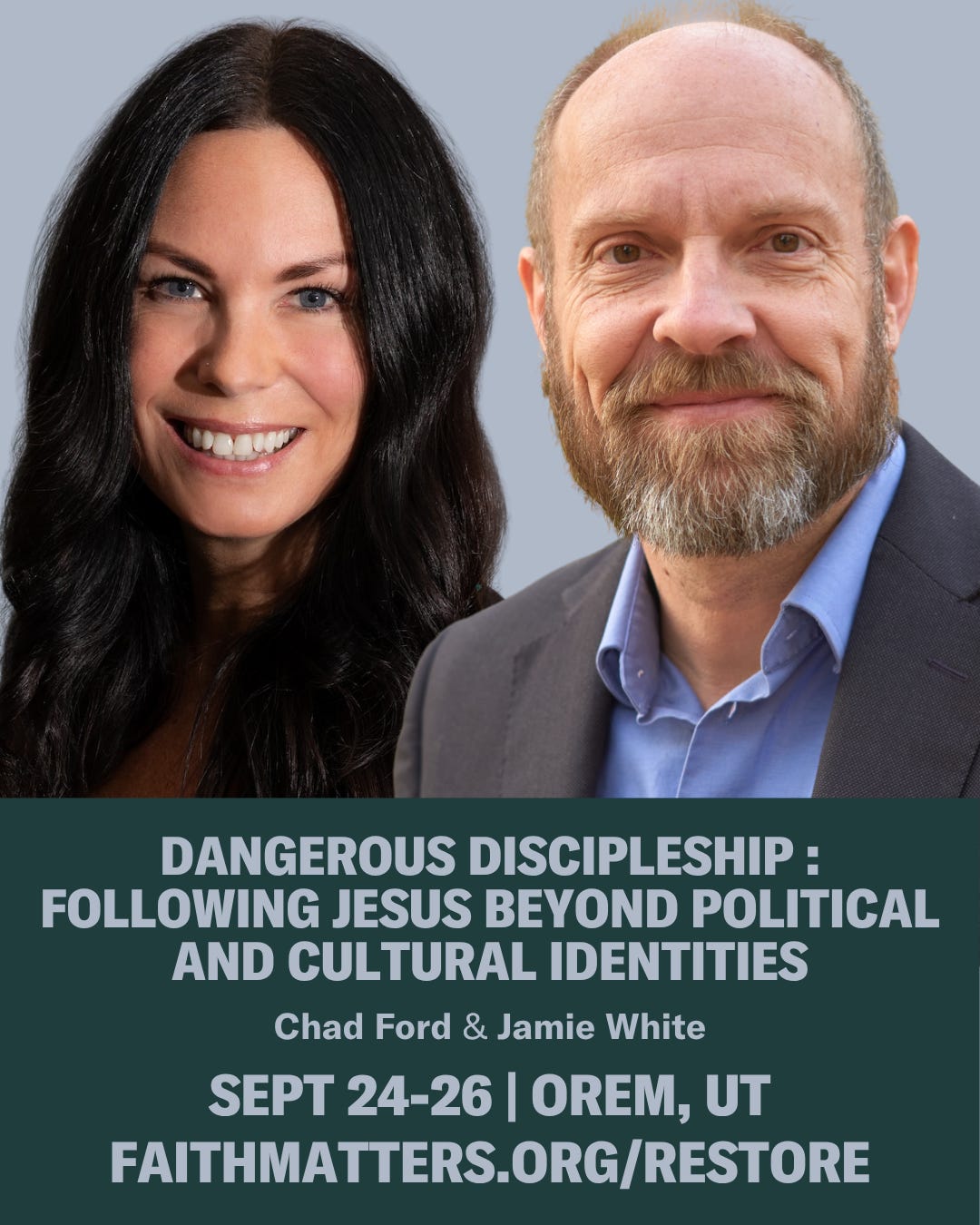
In every generation, followers of Jesus have claimed their political ideologies, religious cultures, and media to reflect the “true” beliefs of Jesus. Our politics, religious communities, and even broader popular culture can gradually, and even dramatically, reshape our understanding of Jesus and His Kingdom. This interactive workshop invites us to re-examine our identities and rediscover practices that cultivate deeper discipleship to Jesus. Drawing from scripture, history, social psychology, conflict transformation theory, and the Christian contemplative tradition, participants will learn how to stay rooted in Jesus while faithfully engaging a polarized world.
“Peacemaking 101: Where to Start” - Patrick Mason (Friday, Sept 25 at 11 am and Saturday, Sept 26 at 9 am)
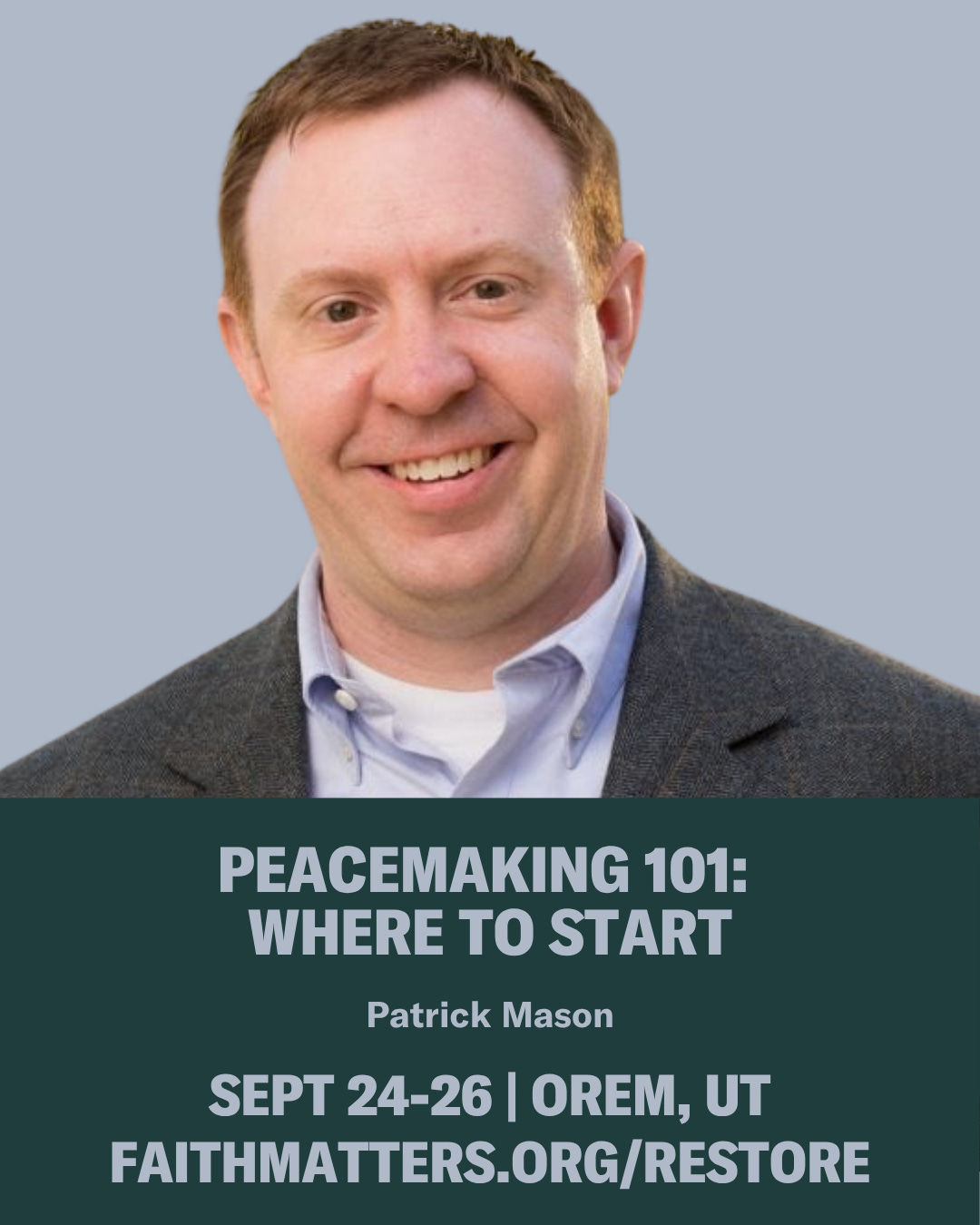
In his April 2026 General Conference talk, President Oaks urged all Latter-day Saints to learn and implement “the language and methods of peacemakers.” Perhaps you have felt the desire to make peacemaking a central part of your discipleship, but you don’t quite know what it means or where to start. In this session, Patrick Mason will teach some basic concepts and skills for how you can take the next step on your journey of being a peacemaker.
“Out of the Rubble: Rebuilding a Resilient Faith after Deconstruction” - Pastor Jamie White (Friday, Sept 25, at 2 pm)
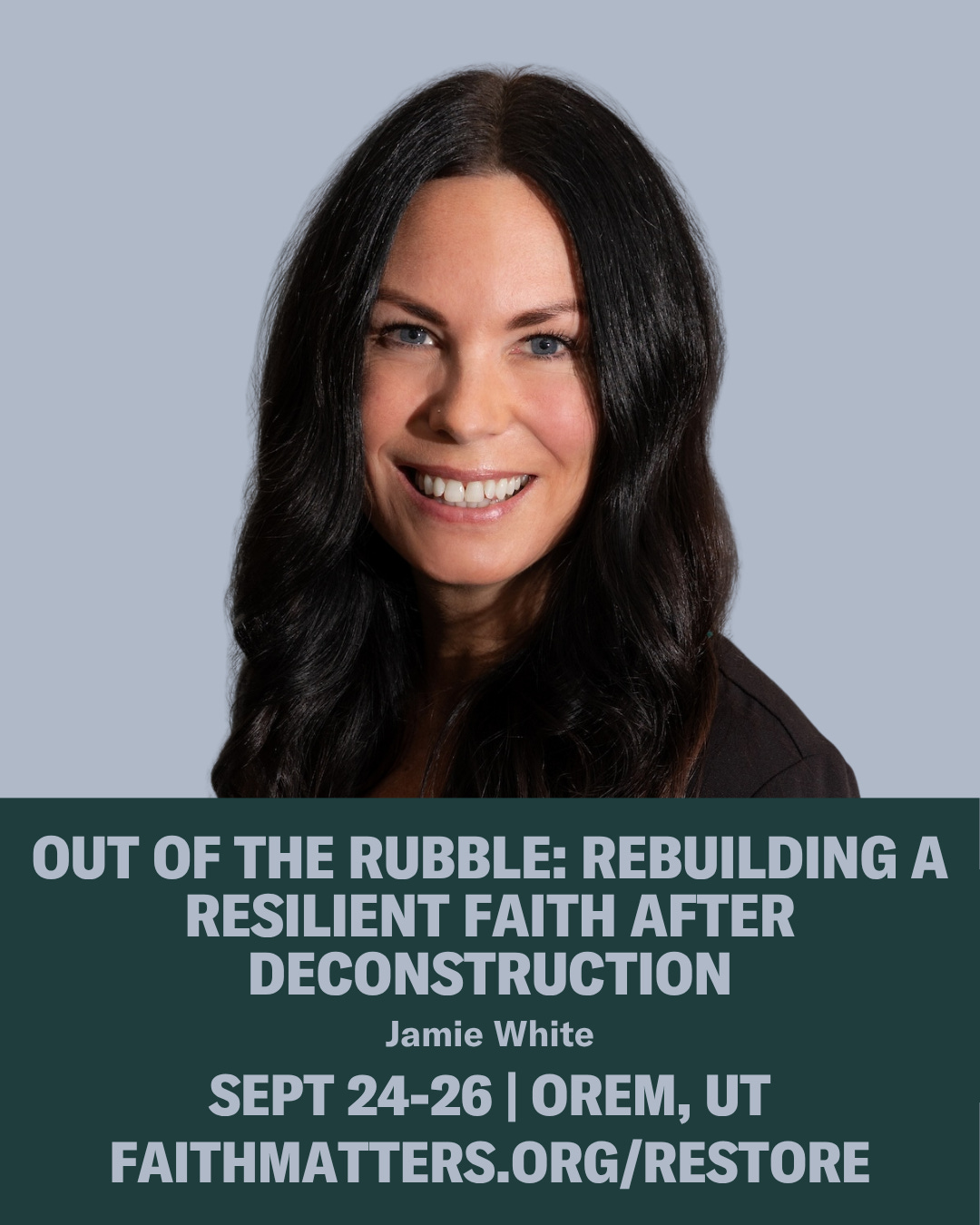
Faith deconstruction often feels like a pretty major demolition in our lives, as if everything we once counted on to stand firm has somehow collapsed like piles of rubble all around us. It can be easy to get stuck there—in the pain, disorientation, and doubt—with no clear path for how to rebuild something better. Yet beyond our faith crisis, church hurt, or dismantling of certainty, there is hope for a deeper, more resilient faith in Christ. This workshop will explore how to rebuild, offering participants a safe space to explore what comes next without rushing the healing process, while identifying spiritual truths worth keeping, developing practices rooted in love, and embracing new rhythms of grace, mystery, and authentic community. Standing among the rubble doesn’t have to mean you’ve lost your faith. In fact, it can be the beginning of something stronger, deeper, and more faithful than before.
“Holy Attention: An Experiential Workshop on Presence, Wonder, and Communion” by Melissa Mason and Amanda Ford (Friday, Sept 25 at 3 pm)
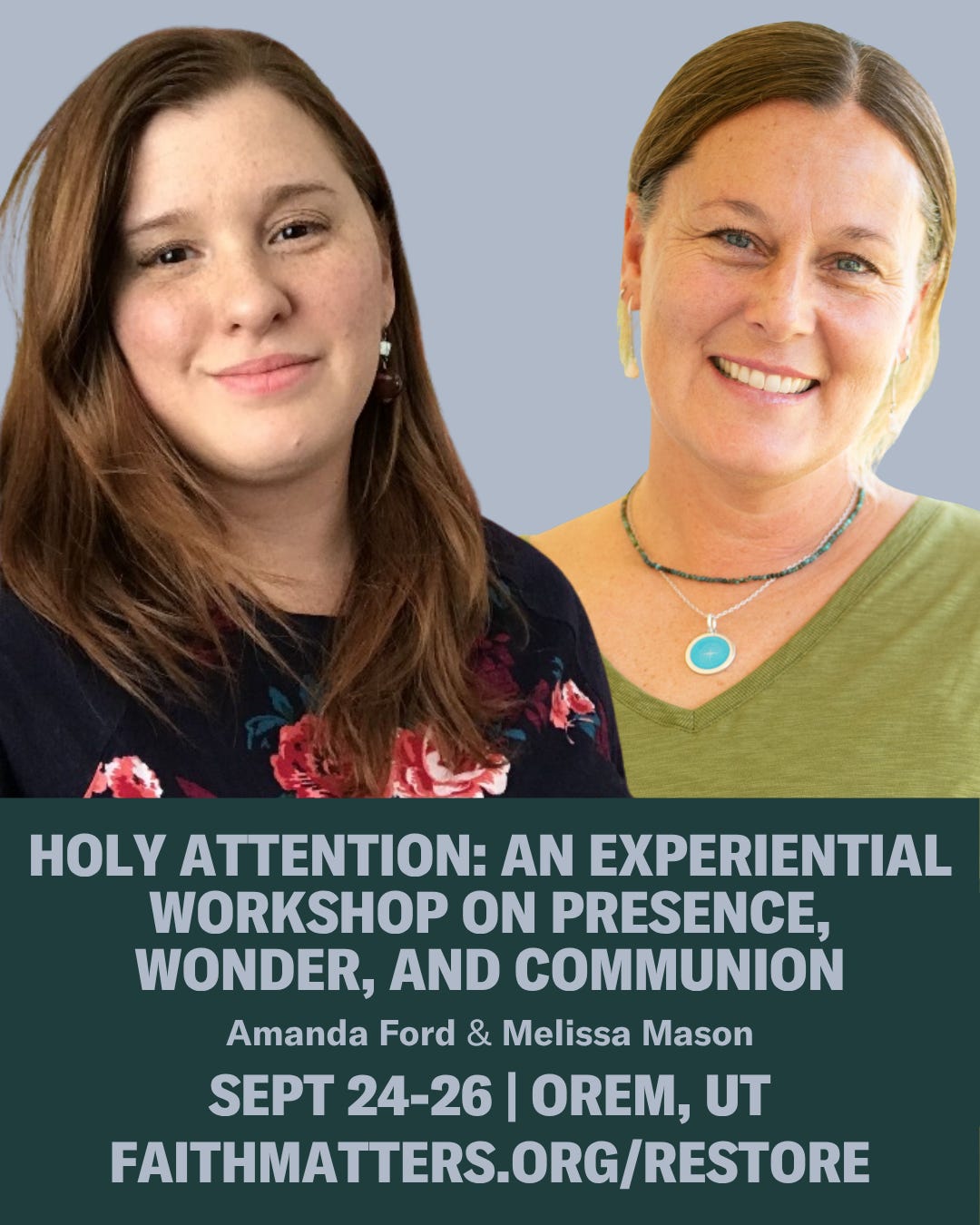
What does it look like to pursue God when faith feels inconsistent, attention drifts, or certainty fades? In this workshop, therapists and educators Melissa Mason and Amanda Ford invite us to explore how permission to rest can become an invitation to deeper communion with God. Through experiential practices that broaden our imagination of faithful discipleship, we’ll discover how attention, silence, breath, movement, creativity, beauty, and relationships can become pathways to deeper connection with God, ourselves, and each other.
“Holding Sacred Conflict: Leading Through Political Division, Faith Transition, and Relationship Conflict” by Chad Ford (Saturday, Sept 26 from 10-12 pm)
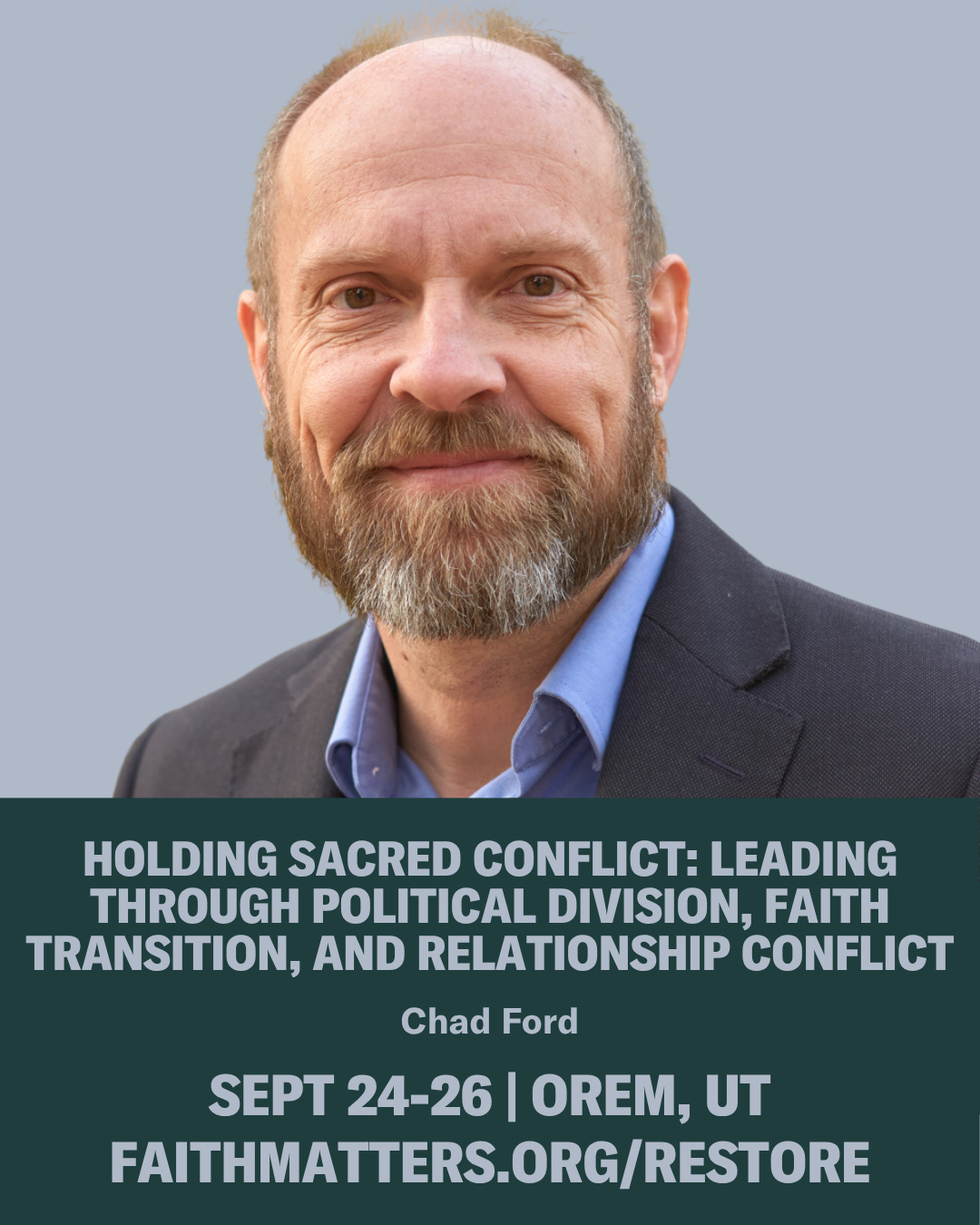
Congregations are facing serious turbulence—from political polarization and cultural change to faith transitions. Many faith leaders fill ill-equipped to help their congregants navigate these difficult challenges. Too often we either end up avoiding these conversations or trying to resolve them too quickly. This workshop aims to give Bishops, Relief Society and Elders Quorum presidencies, and Young Women and Young Men leaders practical tools to step into these conflicts to create belonging, deepen understanding, and help people navigate difficult conversations while remaining rooted in Christlike love and discipleship.
“Rooted: Centering Christ in Everything” by Patrick and Melissa Mason (Saturday, Sept 26 at 2 pm)
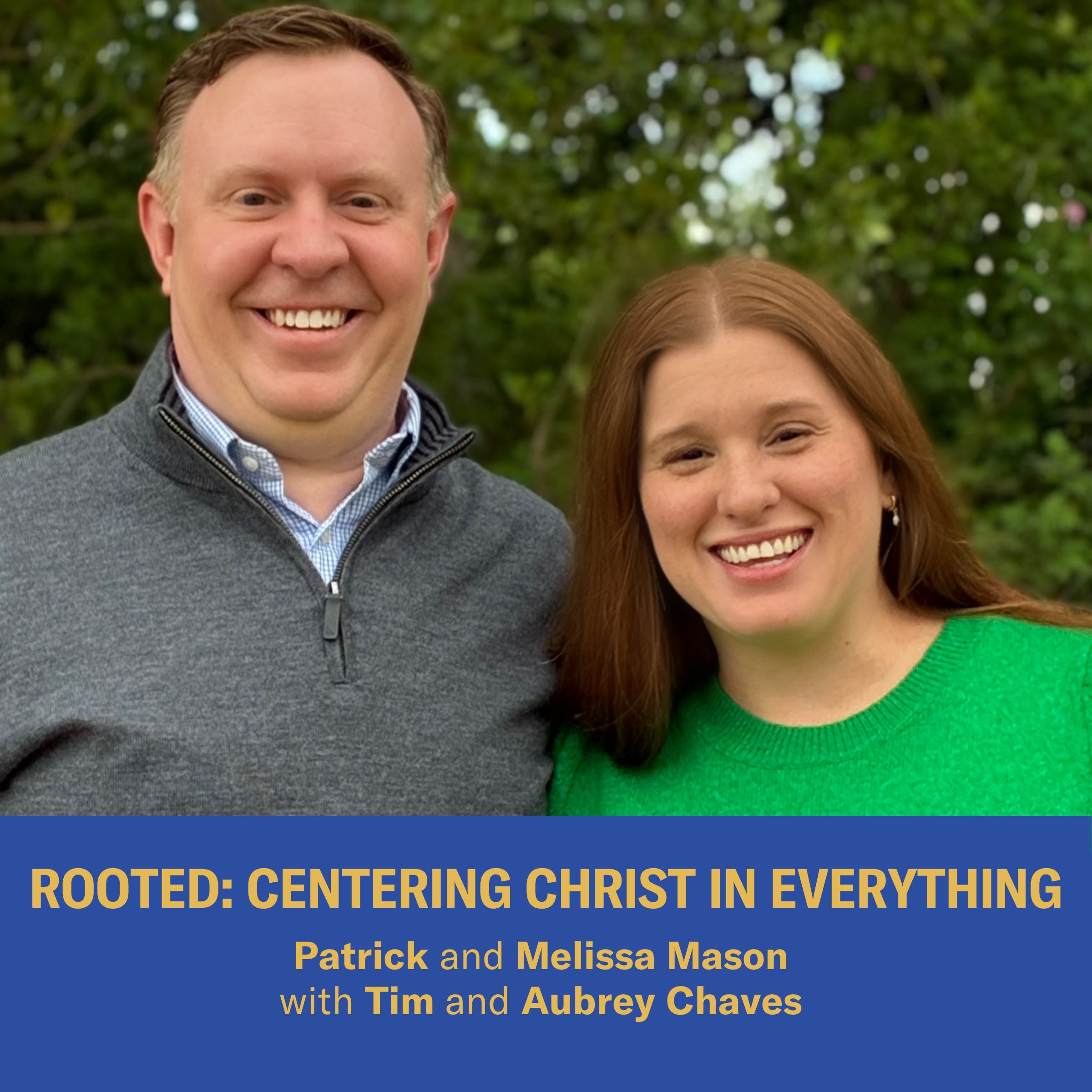
Music and the Spoken Mantra: A Kirtan Musical Immersion by Ravi Gupta (Saturday, Sept 26 from 2-4 pm)
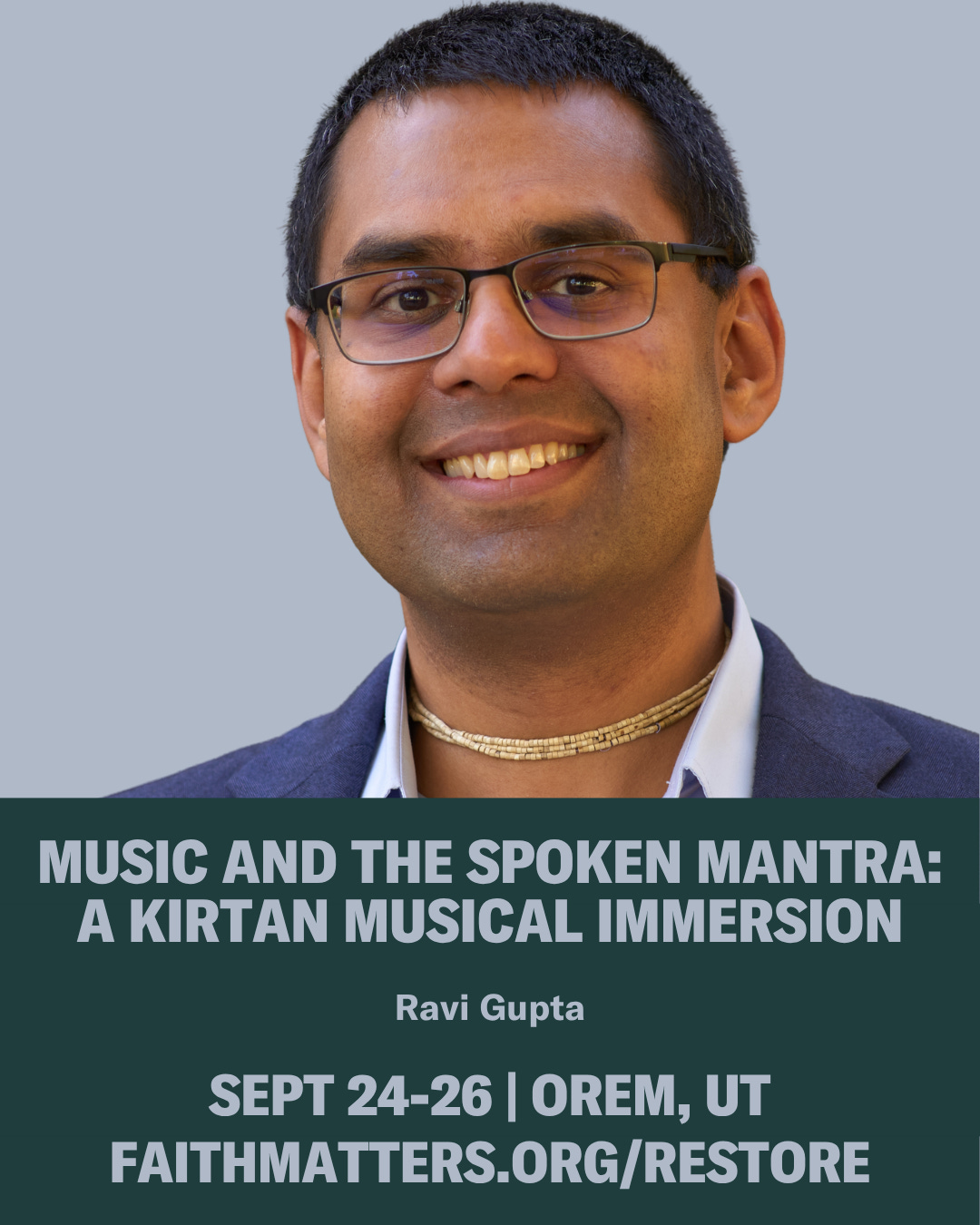
Kirtan is an ancient Hindu practice from India that aligns our body and mind through music and mantra. Participants in this workshop will explore the power of devotional music to create pathways of peace within ourselves and in community with others. We will learn techniques of mantra meditation as we immerse ourselves in sacred sound. No prior experience with kirtan is needed.
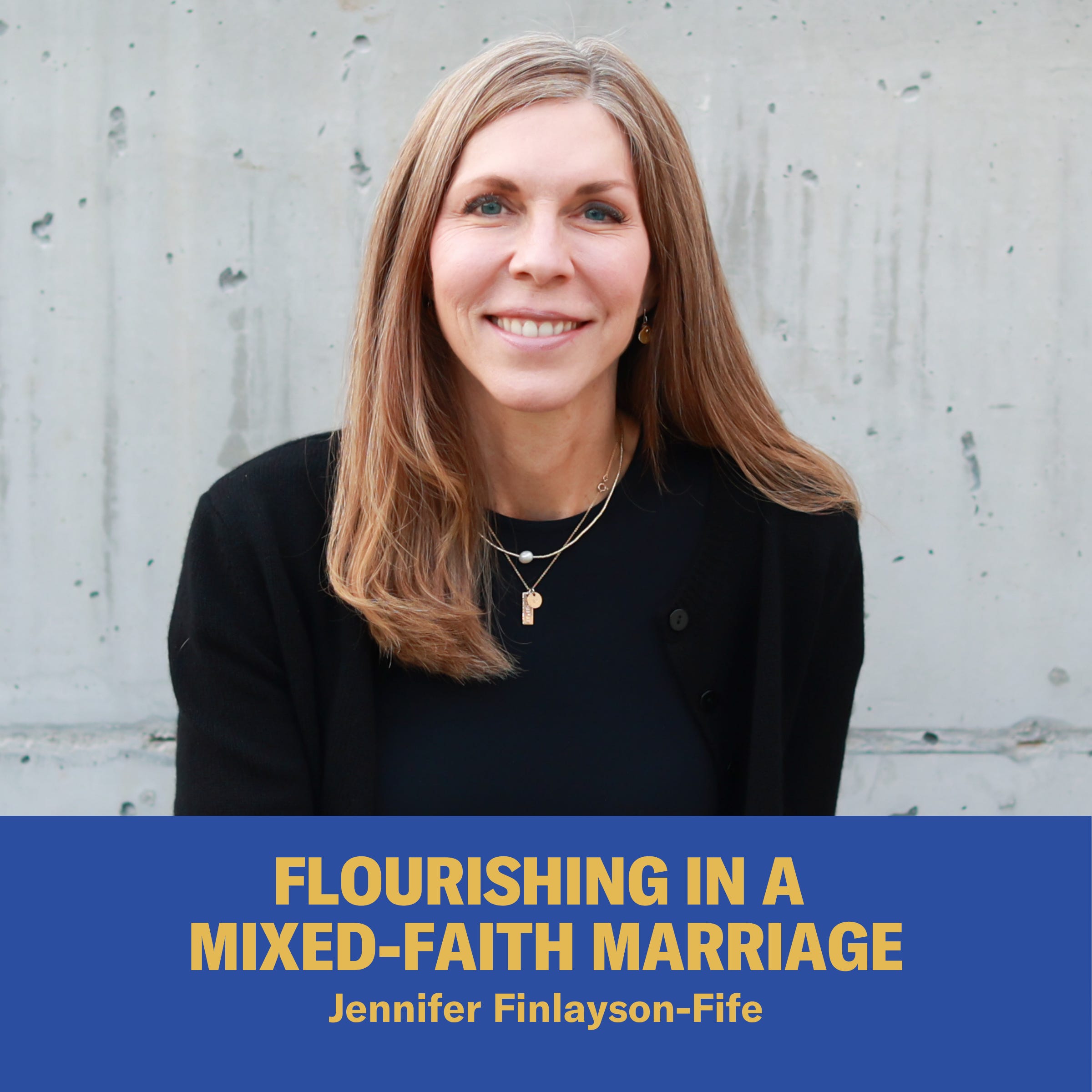
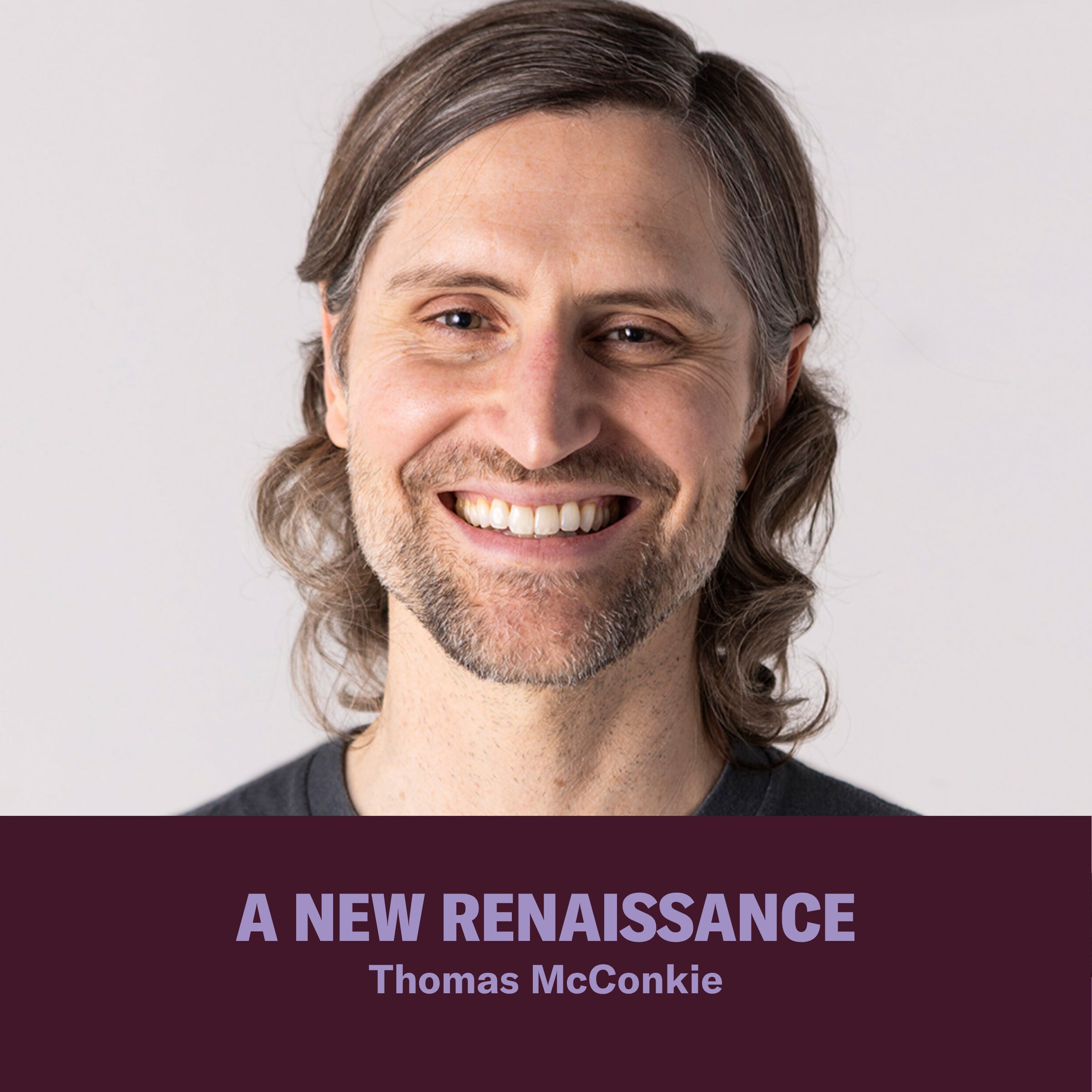
There are also so many other cool workshops from our friends at Faith Matters like Thomas McConkie, Jennifer Finlayson-Fife and so many more!
Can’t make it this year? All sessions will be recorded and made available to every ticket holder following the event! There will be no livestream option this year, but the recordings can be preordered today.
I love this story so much! Thank you for sharing, you have brightened my day when the world seems impossibly gloomy