


I spent April 27–29 at the One America Movement Summit, gathered with faith leaders and peacebuilders from across traditions—pastors and rabbis, imams and organizers, each carrying, in their own way, the quiet and often invisible burden of holding communities together in a time when so much feels like it is coming apart.
It was a powerful, hopeful and energizing experience.
I was there representing Waymakers, as well as the interfaith leadership work I do through Utah State University and the Heravi Peace Institute. The summit is a convergence of those worlds—academic, practical, spiritual—all meeting in the shared recognition that how we engage conflict is becoming one of the defining questions of our time.
There was a particular kind of gravity to the space. You could feel how much is at stake in this moment—how deeply political division has seeped into the relational and spiritual fabric of congregational life. You could also feel an almost defiant hope that, together, we could do something about the rising tide of contempt and polarization that America has succumbed to.
Part of that hope is embodied in the work of the One America Movement itself. At a time when religion is often seen as a driver of division, they are doing the difficult, patient work of helping faith communities become sites of bridge-building rather than fracture. Their model—bringing together leaders across theological and political differences, equipping them with tools for dialogue, and fostering sustained relationships rather than one-off conversations—is not flashy, but it is deeply consequential. They were an important partner for Waymakers when we put together our Where Peace Begins videos and our first REPAIR conference.
I left with a deep sense of gratitude for their leadership and a renewed conviction that what they are building matters—not just for individual congregations, but for the broader civic and moral fabric of the country.
The Sacred Iceberg
I was invited to offer a 75-minute workshop on Transformative Mediation for Faith Leaders: Navigating Political Polarization in Congregations.
One of the core ideas I shared—and that was echoed throughout the summit—is this: The greatest challenge facing faith communities right now isn’t disagreement. It’s how we hold each other through disagreement.
Much of our public discourse is stuck in what I call debate mode. We correct. Defend. Try to convince, convert and win the conversation. There is a slew of religious actors on social media attempting this now. It attracts followers and gets content creators pats on the back when they say something the listener agrees with.
But in deeply polarized environments—especially in religious communities—this approach often backfires. It hardens positions, escalates mistrust, and fractures relationships.
Transformative mediation invites a different posture:
Empowerment: Helping people clarify what they think, feel, and need
Recognition: Helping people feel seen—and see the humanity in others
It shifts the goal from solving a problem to changing the interaction itself. One of the most important tools we explored in the workshop is what I call the Sacred Iceberg.
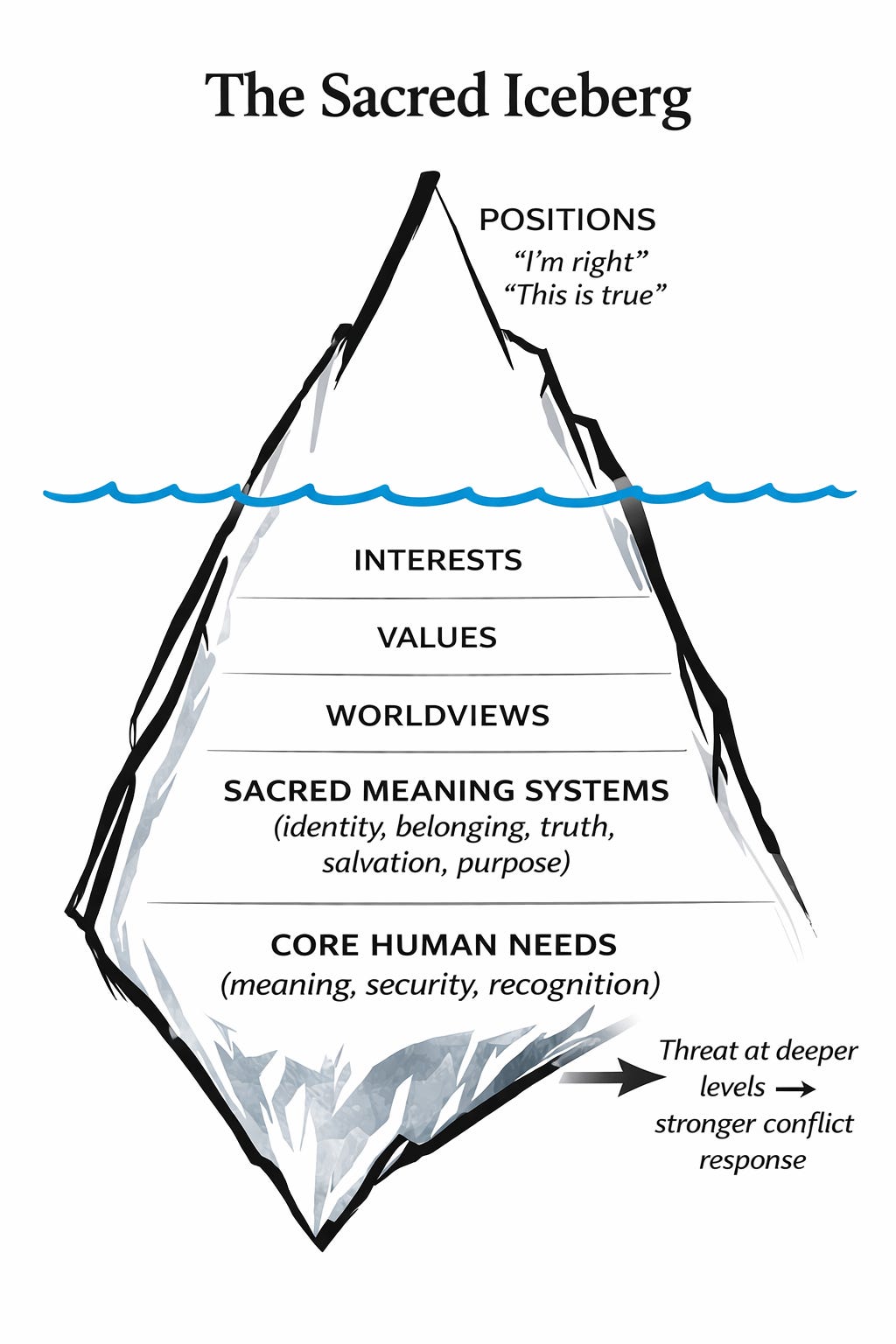
Most conflicts operate at the surface—where we see positions, opinions, and arguments. But that’s only the tip. Beneath the surface lies a much deeper structure:
Interests (what I want)
Values (what matters to me)
Worldviews (how I understand reality)
Identity (who I am)
Needs (what I must have to feel safe, seen, and whole)
In faith communities, this iceberg becomes even more sacred. Because what’s underneath isn’t just preference—it’s meaning, belonging, and often a person’s relationship to God. So when someone argues about politics in a congregation, they may not just be defending a policy position.
They may be protecting their sense of moral integrity or their understanding of truth or their place in the community or their connection to the sacred. Sometimes it’s all of these thing.
This is why surface-level solutions and the debate style of communication often fail. You can’t resolve a sacred conflict with shallow tools. When we work with the Sacred Iceberg, the goal is not to argue better. It’s to listen deeper with curosity.
Some of the most powerful questions we practiced were incredibly simple:
“What are you feeling right now as you think about this?”
“What feels most important to you underneath this?”
“What are you worried about losing?”
“What do you need to feel seen, heard, and safe?”
These questions don’t move us toward agreement. They move us toward understanding And understanding is often the first step toward transformation.
One of the most meaningful threads running through the summit was a shared recognition across traditions: Conflict, when held well, can be sacred. Not because it’s easy or comfortable. But because it reveals what matters most.
In that sense, the work of a faith leader in conflict is not unlike the work of a pastor, rabbi, or imam in any sacred moment:
To help people stay present.
To help them see each other.
To help them not run away from the conflict or relationship.
To help them navigate both boundaries (for what I need respected) and bridges (for what I can offer another).
Healthy conflict requires all of this.
When we’re not present, we miss what matters.
When we don’t truly see each other, we flatten and judge.
When we turn away or cut off, connection breaks.
Too many boundaries, and we isolate.
Too many bridges, and we lose ourselves.
The work is to hold all of these core concepts—compassionately. There was a moment in the workshop when this shift became palpable.
We were doing role-plays and having participants discuss a tension they are holding in their own congregations and lives. Participants moved from analyzing conflict at a distance to recognizing themselves within it. The abstractions gave way to particular relationships, specific conversations, the names and faces of people they care about. The room softened. There were tears, epiphanies and a renewed desire to do the sacred work of REPAIR.
Toward More Christ-like Peacebuilding
Toward the end of the summit, I found myself in a smaller, more intimate gathering—a roundtable with a number of Latter-day Saint interfaith peacemakers who are doing thoughtful and important work in this space. I got to sit with Jennifer Walker Thomas, co-executive director of Mormon Women for Ethical Government, alongside The Wheatley Institute’s Paul Lambert and Elder Andrew Child, who serves as an Area Authority in the Chicago region. We were also joined by Zach Davis Executive Director of Faith Matters, along with local leaders deeply engaged in interfaith and diplomatic work, including R. Bruce Duffield and Stephen and Pamela Caine.
The conversation was candid and searching. We spoke about the future of Latter-day Saint peacebuilding—about the theological and cultural resources within the tradition, the growing networks of interfaith engagement, and the responsibility to contribute meaningfully to a world increasingly defined by difference and division. There was no illusion that the path forward will be simple, but there was a shared recognition that the work is necessary, and that it is already, in many ways, underway.
As I left the summit, what lingered was not a set of conclusions but a kind of orientation. A reminder that the work before us is less about eliminating conflict than about transforming the way we meet one another within it. That even in a time marked by polarization and mistrust, there remains a quiet but persistent possibility for connection—one that depends, in no small part, on our willingness to listen more deeply, to remain present a little longer, and to trust that something sacred can still emerge in the space between us.
More Faith Leader Mediation Training
This Fall we are going to pilot our first 20 hour faith leader transformative mediation training in SLC. If you are interested or know someone who is, please contact Chad Ford over at chadford.substack.com
We hope you continue to join us as we explore the intersections between faith, conflict and peace and continue to engage the skills and character of Christian peace builders.
Peace Picnic
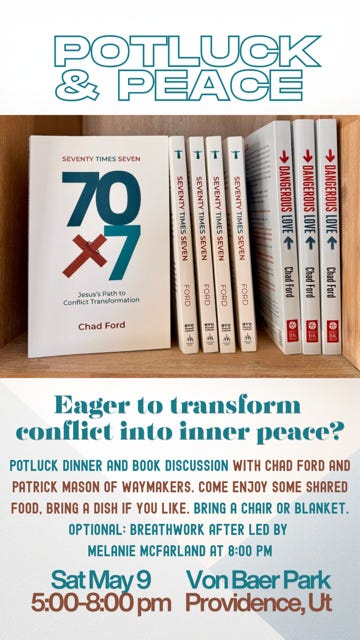
Come join Chad Ford and Patrick Mason of Waymakers, Casey McFarland of Pioneering Paradoxes and the folks at That’s Church for a Peace Picnic at Von Baer Park in Providence, Utah on Saturday May 9 from 5 to 8 pm.
We will have a potluck, some games and a cool, interactive discussion between Chad, Casey and Patrick on Chad’s book: Seventy Times Seven: Jesus’ Path to Conflict Transformation.
We’d love to see you there.
REPAIR coming to Washington DC
Our REPAIR conference is coming to Washington DC for a half day event on Saturday, September 19th for a half day event. Patrick Mason, Chad Ford, Thomas Griffith and others will be speaking and doing workshops. More details are coming. But mark you calendars now!
I absolutely love this. There so much to learn and unpack. I cannot wait to add my 2 cents to this important talanoa !!! Faafetai Chad !
Just shared about the interfaith training in SLC in a virtual Dignity in Faith gathering hosted by The Dignity Index. Hoping people saw it...it was right at the end in the chat...but I'm sharing nonetheless. I'll also post about it in the Circle community space that Dignity Index has for people interested in intra- and inter-faith work.