


I spent April 27–29 at the One America Movement Summit, gathered with faith leaders and peacebuilders from across traditions—pastors and rabbis, imams and organizers. These people who carry the responsibility of holding their faith communities together in a time where everything feels like it’s coming apart.
It was a powerful, hopeful and energizing experience.
I was there representing Waymakers, as well as the interfaith leadership work I do through Utah State University and the Heravi Peace Institute. The summit is the perfect convergence of those worlds for me—academic, practical, spiritual. We are all wrestling with the challenge of how to better navigate conflict in such difficult times.
There is so much at stake in the moment—deep political and social division have seeped into the relational and spiritual fabric of congregational life. This isn’t the first time we’ve faced these challenges. This challenge is a historical one, not a recent one. Still, as the tide of contempt rises, it was heartening to see an almost defiant hope with these leaders that maybe we could do something about it before it’s too late.
The One America Movement embodies some of that hope. They are doing incredible helping faith communities become sites of bridge-building. Their model—bringing together leaders across theological and political differences is imperative. They were an important partner for Waymakers when we put together our Where Peace Begins videos and our first REPAIR conference.
The Sacred Iceberg
I was invited to offer a 75-minute workshop on Transformative Mediation for Faith Leaders: Navigating Political Polarization in Congregations.
One of the core ideas I shared is this: The greatest challenge facing faith communities right now isn’t disagreement. It’s that we don’t know how to hold each other through disagreement.
Much of our public discourse is stuck in what I call debate mode. We correct. Defend. Try to convince, convert and win the conversation. There is a slew of religious actors on social media attempting this now. But in deeply polarized environments—especially in religious communities—this approach typically just hardens positions, escalates mistrust, and widens the divide.
Transformative mediation offers a more hopeful path forward:
Recognition: Helping people feel seen, and see, the humanity in others as well as their contribution to the conflict
Empowerment: Helping people feel like conflict isn’t just happening to them, but there’s something they can do about it.
Transformative mediation shifts the goal from solving a problem to changing the conflict interaction itself. One of the most important tools we explored in the workshop is what I call the Sacred Iceberg.
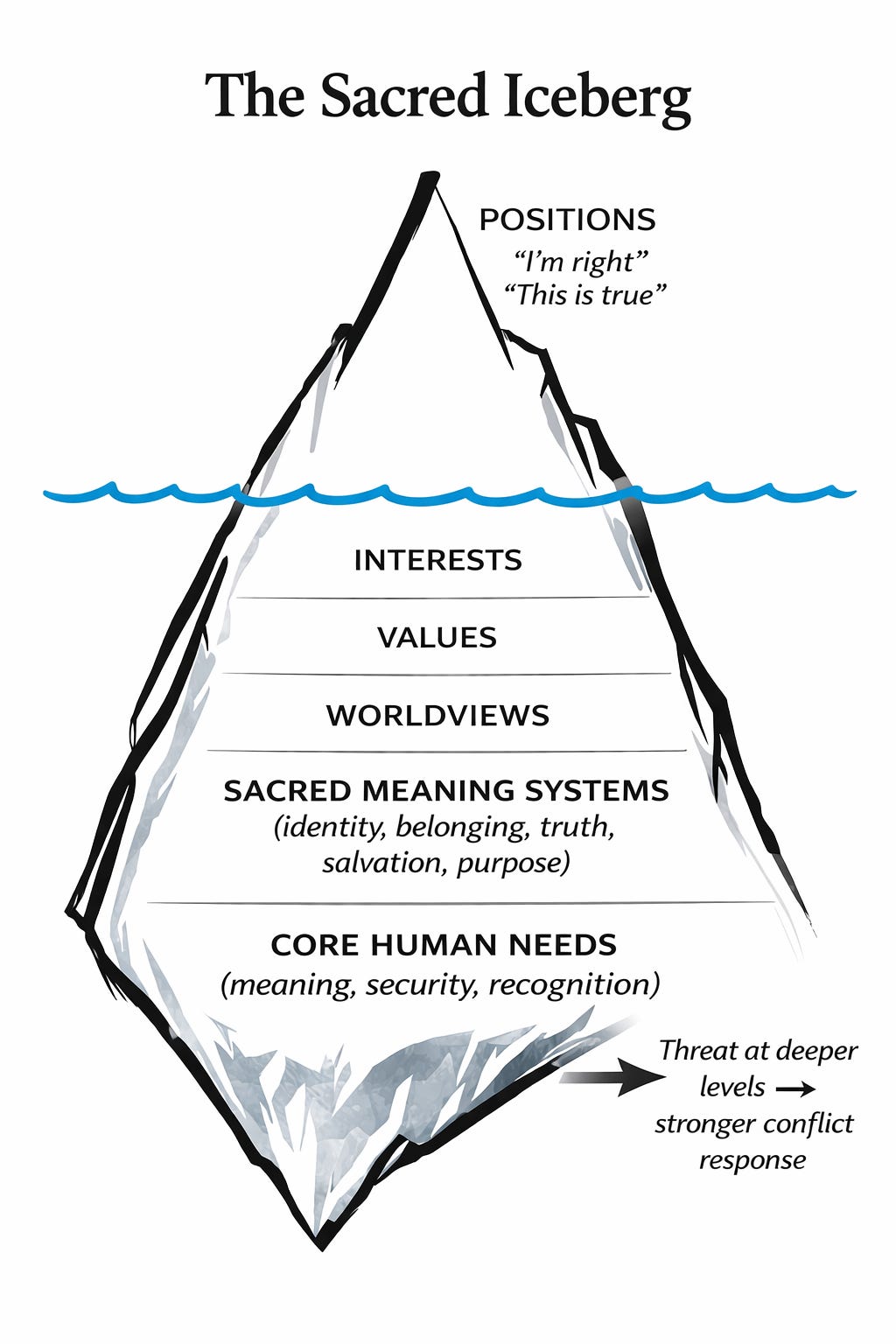
Most conflicts operate at the surface of the iceberg where our positions and arguments are clearly visible. But that’s only the tip of the iceberg and our conflict. Beneath the surface lies the deeper meaning and challenges of conflicts:
Interests (what I want)
Values (what matters to me)
Worldviews (how I understand reality)
Identity (who I am)
Needs (what I must have to feel safe, seen, and whole)
In faith communities, this iceberg grows more sacred. What lies beneath involves meaning, belonging, and often a person’s relationship to God. These are often non-negotiable to a person of faith.
Conflict can become about protecting a sense of meaning, belonging or the very nature of truth itself.
Those types of conflicts aren’t solved through debate or negotiation. When the parties bring their God to the table, logic and reason aren’t the way to increased understanding. The aim of the Sacred Iceberg is to develop deeper understanding, not just to win a debate.
Some of the most powerful questions we practiced included:
“What are you feeling right now as you think about this?”
“What feels most important to you underneath this?”
“What are you worried about losing?”
“What do you need to feel seen, heard, and safe?”
As we practiced those questions it became clear that while conflict certainly can be destructive, when we hold it well and carefully, can be sacred.
The work of a faith leader in conflict is not unlike the work of a pastor, rabbi, or imam in any sacred moment:
You help people stay present.
You help them see each other and themselves.
You invite them not to run away from the conflict nor abandon the relationship.
You provide them tools to navigate both boundaries (for what I need respected) and bridges (for what I can offer another).
Healthy conflict requires all of this.
There was a moment in the workshop when all of this came together in an embodied way. We were doing role-plays and participants were discussing a tension they were holding in their own congregations and lives. Slowly, the participants in the room moved from analyzing conflict at a distance to recognizing themselves within it. As they recognized themselves, abstraction turned to focus on particular relationships, specific conversations, the names and faces of people they care about. There were tears, and a renewed desire to do the sacred work of REPAIR.
Toward More Christ-like Peacebuilding
Toward the end of the summit, I joined a smaller, more intimate gathering of Latter-day Saint interfaith peacemakers. I got to sit with Jennifer Walker Thomas, co-executive director of Mormon Women for Ethical Government, alongside The Wheatley Institute’s Paul Lambert and Elder Andrew Child, who serves as an Area Authority in the Chicago region. We were also joined by Zach Davis Executive Director of Faith Matters, along with local leaders deeply engaged in interfaith and diplomatic work, including R. Bruce Duffield and Stephen and Pamela Caine.
We spoke about the future of Latter-day Saint peacebuilding—about the theological and cultural resources within the tradition, the growing networks of interfaith engagement, and the responsibility to contribute meaningfully to the cause of peacemaking.
I left with hope. Hope that even though we live in a time marred by polarization and enmity, there are so many people quietly, persistently trying to open up the space for connection, trust, understanding, and peace. They believe that something sacred can still emerge in the space between us, and our faith has a responsibility to make conflict sacred again.
More Faith Leader Mediation Training
This Fall we are going to pilot our first 20 hour faith leader transformative mediation training in SLC. If you are interested or know someone who is, please contact Chad Ford over at chadford.substack.com
We hope you continue to join us as we explore the intersections between faith, conflict and peace and continue to engage the skills and character of Christian peace builders.
Peace Picnic
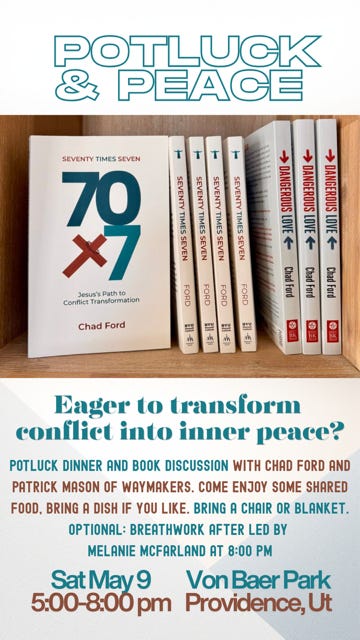
Come join Chad Ford and Patrick Mason of Waymakers, Casey McFarland of Pioneering Paradoxes and the folks at That’s Church for a Peace Picnic at Von Baer Park in Providence, Utah on Saturday May 9 from 5 to 8 pm.
We will have a potluck, some games and a cool, interactive discussion between Chad, Casey and Patrick on Chad’s book: Seventy Times Seven: Jesus’ Path to Conflict Transformation.
We’d love to see you there.
REPAIR coming to Washington DC

Our REPAIR conference is coming to Washington DC for a half day event on Saturday, September 19th for a half day event. Patrick Mason, Chad Ford, Thomas Griffith and others will be speaking and doing workshops. More details are coming. But mark you calendars now!